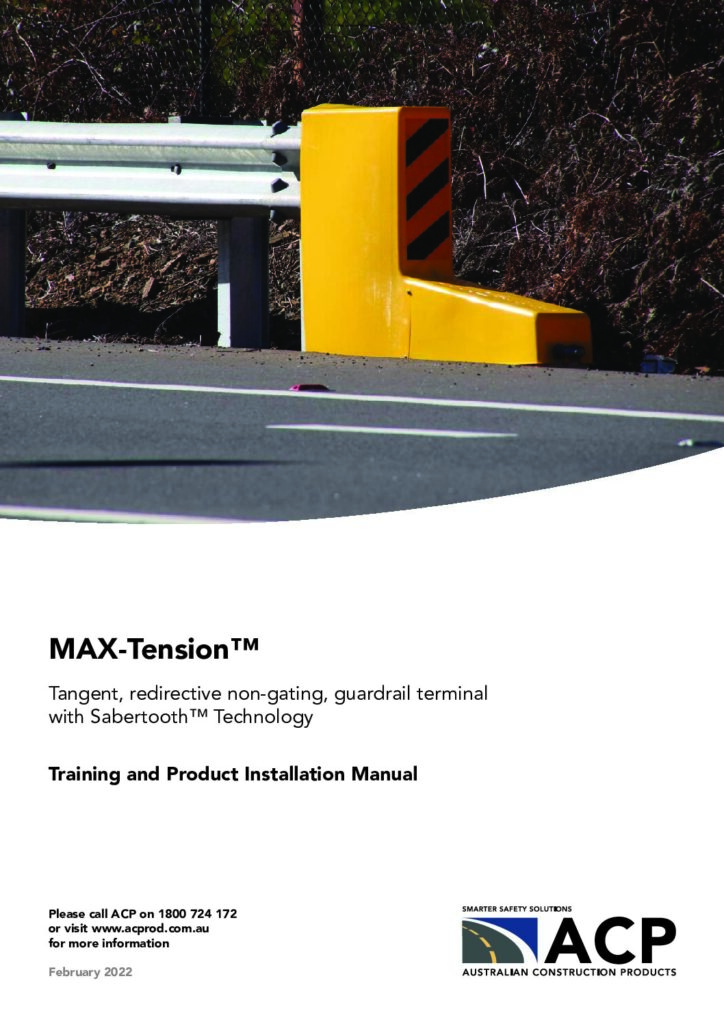
The MAX-Tension Terminal is an energy-absorbing, tangential guardrail end terminal, designed to minimise the severity of impacts occurring at the end of the safety barrier system. The system has a tension-based design along with an energy-absorbing coupler that utilises an innovative cutting-tooth technology. When impacted head-on, deceleration is controlled by friction in the tension cables and by cutting the downstream guardrail panels. The narrow design of the impact head reduces the potential for nuisance impacts and is easily identified by the highly visible yellow nose-cone.
Product Features
MASH TL3 Compliant
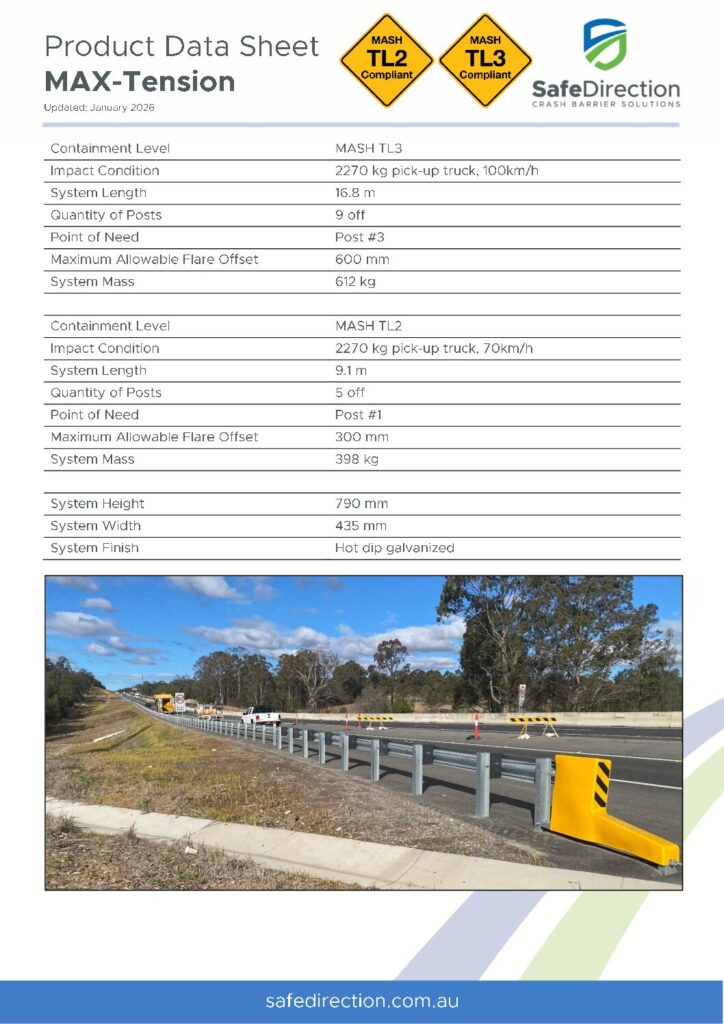
Containment of a 2270 kg pickup truck travelling at 100 km/h.
RamShield W-Beam has significantly advanced the containment level of guardrail by introducing patented technology into the behaviour of the post during impact.
The MAX-Tension tangent end terminal with Sabertooth technology features the next level of impact performance in an ultra-slim design. The system has a tension-based design along with an energy-absorbing coupler that utilises an innovative cutting-tooth technology. When impacted head-on, deceleration is controlled by friction in the tension cables and by cutting the downstream guardrail panels. When a side impact occurs, tension cables can help safely redirect a motorist away from the hazard.
What is the advantage of the tension-based cables?
Tension-based cables control deceleration and increase redirective performance.
What crash testing has been performed with the MAX-Tension?
The MAX-Tension has been crash tested in accordance with MASH Test Level 3 (TL3) of the Manual for Assessing Safety Hardware (MASH).
What is a tangential guardrail end terminal?
A tangential guardrail end terminal is aligned parallel to the roadway, rather than flared away from traffic. The terminal impact head directly faces approaching traffic, enabling it to absorb or dissipate energy in a head-on collision.
What is the definition of terminal point-of-need?
Since all w-beam guardrail end terminals fall into the gating category, it is important that the terminal point-of-need is identified. This is the location along the terminal that has demonstrated complete containment and re-direction when subjected to a 2,270 kg pick-up truck impacting at 25 degrees. When assessed for MASH TL3 conditions, the speed of the impact is performed at 100 km/h.
What is the MAX-Tension point-of-need?
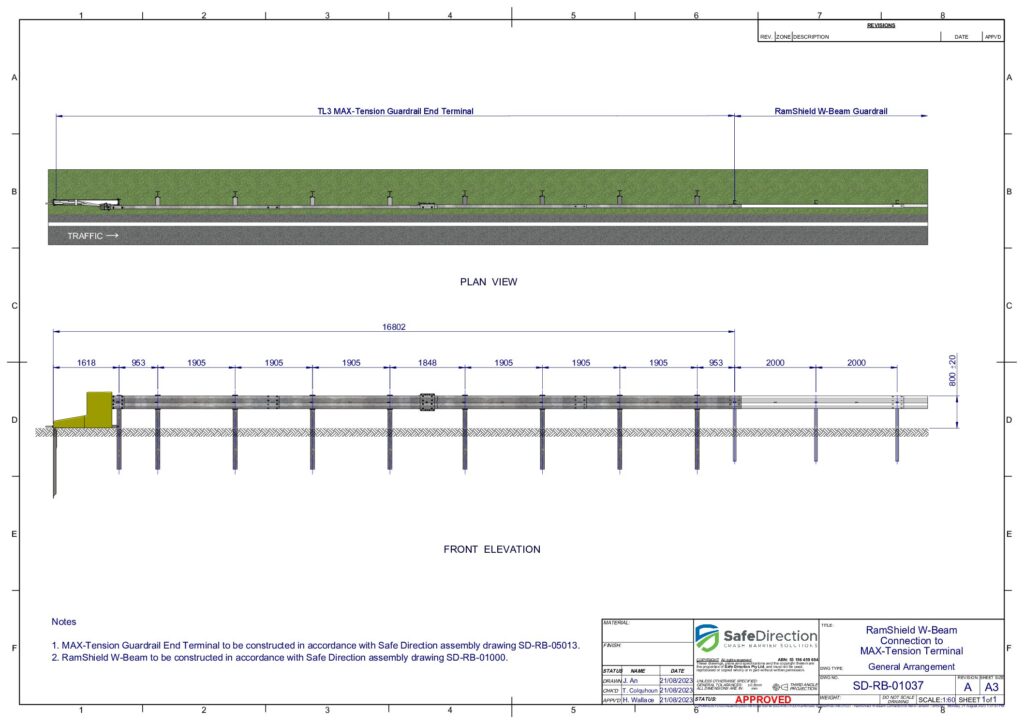
The MAX-Tension point-of-need is post location 3, a distance of 4.5 m downstream from the ground anchor.
What is length of the MAX-Tension terminal?
The length of the MAX-Tension terminal measured from the ground anchor is 16.8 m.
Can curved guardrails be used for the assembly of the MAX-Tension?
The guardrail beams used for the assembly of the MAX-Tension guardrail end terminal must be straight and cannot be factory curved. It is therefore recommended that the guardrail installation be extended to a location that will facilitate parallel alignment of the MAX-Tension with the roadway.
What is the width of the impact head?
The impact head is just 140 mm providing a narrow end terminal design.
How are the MAX-Tension terminals transported?
The MAX-Tension terminals supplied by Safe Direction are packaged as individual units to facilitate ease of handling.
Request a Quote
Sign Up For Safe DirectioN Exclusive Content
Fill out the form below to get access to exclusive Safe Direction content, on our extranet website.