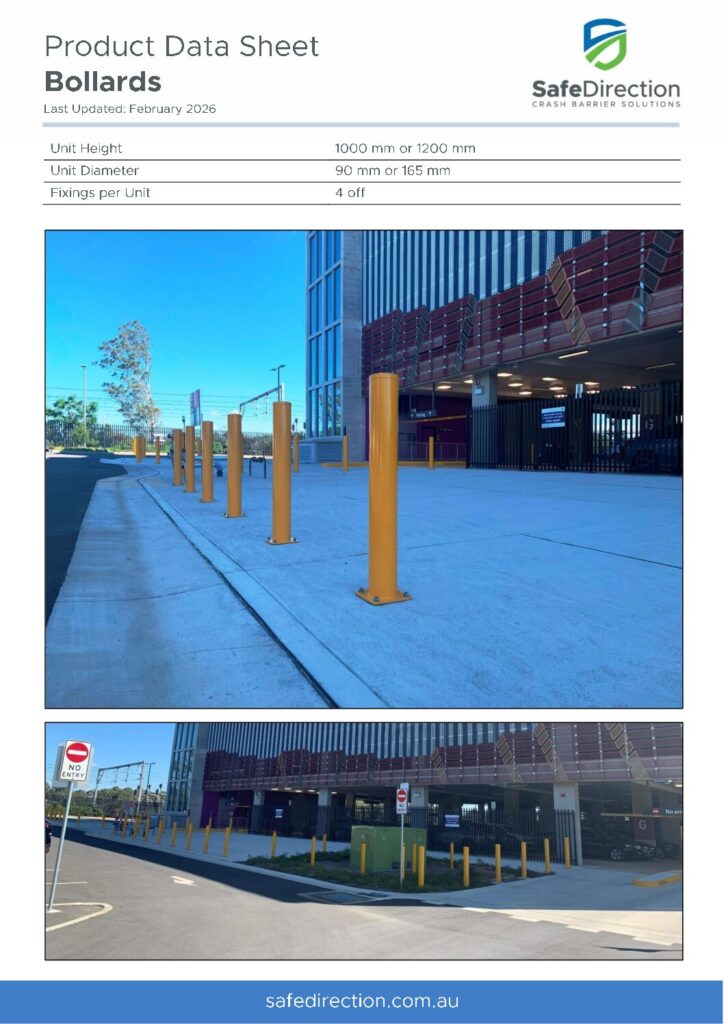
Steel bollards provide visual warning to motorists and pedestrians. They are used to shield plant and equipment and are often positioned adjacent to doorways, providing protection for pedestrians. Steel bollards are design to withstand nuisance impacts, preventing damage to buildings and vehicle encroachment into pedestrian areas. Unlike continuous safety barriers, bollards maintain pedestrian access and can be positioned throughout the car parking area to highlight hazards.
Combining the strength of w-beam guardrail with energy absorbing posts, absorbing vehicle impact energy and reducing the peak loads transferred to the anchor bolts.
Architectural excellence. RhinoStop Elite is the benchmark in modular car park safety barriers combining vehicle impact containment with pedestrian fall protection.
RhinoStop Heavy Duty is designed to withstand high speed impacts up to 30km/h typically encountered at the ends of ramps and straight aisles in car parking areas.
RhinoStop TruckGuard features double height w-beam guardrails supported by heavy duty posts designed to withstand impacts from high-centre-of-gravity vehicles.
Can be configured to a system height of up to 2.5m. The preferred barrier on the upper deck of multi-storey car parks or in parking areas adjacent to critical infrastructure.
Steel bollards are installed to protect pedestrians, buildings, and infrastructure from accidental vehicle impacts. They also help define traffic flow and restrict access to sensitive or pedestrian-only areas.
Where should steel bollards be installed in a car park?
Bollards are typically installed near building entrances, pedestrian walkways, ticket machines, fire escape doorways, and around structural columns or utilities exposed to vehicle traffic.
What is the size of a Safe Direction steel bollard?
Safe Direction steel bollards are 90 mm diameter and 900 mm high.
Is a steel bollard a safety barrier?
No. Steel bollards can withstand nuisance impacts, however they do not provide continuous barrier protection.
When would I install a steel bollard in preference to a safety barrier?
Since a safety barrier is continuous, they restrict the passage of pedestrians. Bollards are often preferred for areas that need to maintain pedestrian access.
What is the recommended spacing between bollards to facilitate pedestrian access?
A spacing of 1.2 m to 1.5 m prevents vehicle entry while allowing comfortable pedestrian movement and wheelchair access.
What material is Safe Direction bollards made from?
Safe Direction bollards are manufactured from 5 mm thick steel.
Request a Quote
Sign Up For Safe DirectioN Exclusive Content
Fill out the form below to get access to exclusive Safe Direction content, on our extranet website.